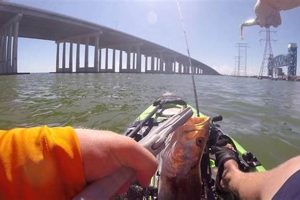
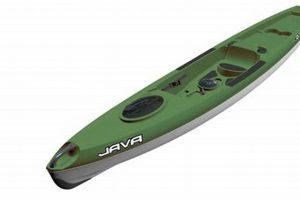
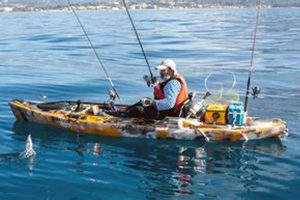
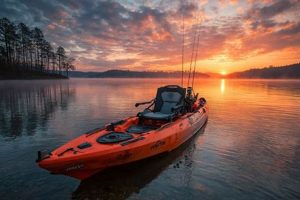
Shallow water angling from a kayak often benefits from the use of a specialized pole to anchor the vessel quickly and quietly. This technique allows the angler to maintain a stationary position in currents or wind, maximizing fishing efficiency by eliminating drift. The poles, typically constructed from lightweight, durable materials like fiberglass or aluminum, are plunged into the bottom substrate to secure the kayak.
This method offers significant advantages for targeting species that inhabit shallow, vegetated areas. It grants anglers precise control over their position, enabling stealthy approaches to fish-holding spots and minimizing disturbance to the surrounding environment. Historically, similar techniques were employed using readily available materials like branches or saplings. Modern advancements in materials and design, however, have led to purpose-built poles optimized for stability, ease of use, and portability.
Further exploration will cover optimal pole selection, proper anchoring techniques in various substrates, and strategies for utilizing this approach in diverse fishing scenarios.
Tips for Effective Shallow Water Kayak Anchoring
Optimizing the use of an anchoring pole enhances stability and fishing success in shallow water environments. Consider these key strategies to maximize effectiveness and minimize environmental impact.
Tip 1: Pole Selection: Selecting the appropriate pole length is crucial. Pole length should be determined by anticipated water depth and kayak height. Adjustable poles offer versatility across diverse fishing locations.
Tip 2: Substrate Considerations: Different bottom compositions require adapted techniques. Muddy or sandy bottoms necessitate deeper pole insertion for secure anchoring, while rocky bottoms may require careful placement to avoid wedging or damage.
Tip 3: Silent Deployment: Avoid sudden, jarring movements when deploying the pole. Slow, controlled insertion minimizes disturbance to the surrounding environment and prevents spooking fish.
Tip 4: Angle of Deployment: Angling the pole slightly downstream or into the prevailing wind enhances stability and resistance against current or wind drift.
Tip 5: Dual Pole Deployment: Utilizing two poles, positioned at opposing angles, provides exceptional stability in challenging conditions, particularly in stronger currents or windy environments.
Tip 6: Environmental Awareness: Exercise caution in areas with sensitive habitats like seagrass beds or coral reefs. Avoid pole placement in these areas to prevent damage to the ecosystem.
Tip 7: Pole Maintenance: Rinse poles with fresh water after each use to prevent corrosion and maintain functionality. Regular inspection for wear and tear ensures longevity.
Adhering to these guidelines ensures a safe and productive shallow water fishing experience, maximizing angling opportunities while minimizing environmental impact.
These techniques provide a foundational understanding for optimizing shallow water kayak anchoring. Further sections will delve into specific fishing strategies and adaptations for various species and environments.
1. Quiet Anchoring

Quiet anchoring represents a critical element of effective stake out pole kayak fishing. Noise disruption readily transmits through water, potentially alarming fish and diminishing angling success. Conventional anchoring systems, involving chains or dragging anchors, generate substantial noise. Stake out poles offer a significantly quieter alternative, enabling anglers to establish a fixed position with minimal disturbance to the underwater environment. This subtle approach proves particularly advantageous when targeting fish in shallow, clear water, where sound travels efficiently and fish are more easily spooked. For instance, when pursuing bonefish on shallow flats, a noisy anchor deployment can scatter schools, whereas a carefully placed stake out pole allows for a stealthy approach and increased opportunities for a successful presentation.
The mechanics of quiet anchoring with a stake out pole involve a controlled and deliberate insertion into the substrate. Rapid or forceful placement generates pressure waves and vibrations that can alert fish. A slow, smooth motion minimizes these disturbances, allowing the angler to remain virtually undetected. Furthermore, pole type and substrate composition influence noise levels. Fiberglass or composite poles tend to produce less noise than aluminum poles when contacting the bottom. Similarly, inserting a pole into soft mud or sand creates less disturbance than placing it among rocks or gravel. Understanding these nuances enhances an angler’s ability to maintain a low acoustic profile.
Mastery of quiet anchoring techniques significantly contributes to stake out pole kayak fishing success. By minimizing noise pollution, anglers increase their chances of approaching fish undetected, leading to improved presentations and higher hook-up rates. This principle applies across various fishing scenarios, from stalking redfish in the salt marsh to pursuing trout in pristine streams. Ultimately, the ability to anchor quietly represents a key skill for any angler seeking to maximize their effectiveness in shallow water environments.
2. Shallow Water Access

Shallow water access represents a defining advantage of stake out pole kayak fishing. These areas, often teeming with life, remain inaccessible to larger, deeper-draft vessels. Kayaks, inherently shallow-drafting, possess the maneuverability to navigate these restrictive environments. Stake out poles augment this capability, providing a means of securing the kayak in extremely shallow depths, precisely where many target species reside. This combination of shallow-draft maneuverability and pinpoint anchoring opens a realm of fishing opportunities unavailable to other angling platforms. For instance, pursuing tailing redfish in mere inches of water becomes achievable, a scenario impractical for even the shallowest-draft motorized boats. Similarly, accessing secluded backwater creeks and ponds, often rich with bass or panfish, becomes readily feasible.
The strategic importance of shallow water access extends beyond mere reachability. Many prized game fish species, including bonefish, permit, and snook, utilize shallow flats as primary feeding grounds. These shallows provide a rich source of crustaceans, baitfish, and other forage. Stake out pole anchoring allows anglers to position themselves directly within these feeding zones, maximizing opportunities for presenting lures or bait effectively. Furthermore, the shallow water environment often provides improved visibility, enabling anglers to sight fish, a highly engaging and rewarding technique. Observing fish behavior directly informs lure selection, presentation, and retrieval strategy, enhancing angling success. Consider speckled trout hunting baitfish in a shallow grass flat. A stake out pole allows an angler to anchor strategically, observe the trout’s movements, and present a lure precisely within the fish’s strike zone.
In summary, shallow water access provided by the stake out pole kayak fishing method represents a critical component of its efficacy. This capability expands fishing opportunities by opening otherwise inaccessible areas, placing anglers directly in the path of target species. Moreover, improved visibility within these shallows enhances the angling experience, allowing for direct observation of fish behavior and more strategic presentations. While navigating extremely shallow water requires careful consideration of tides and potential hazards, the rewards, in terms of increased fishing success and access to unique environments, significantly outweigh the challenges.
3. Enhanced Stability
Enhanced stability stands as a cornerstone of effective stake out pole kayak fishing. A stable platform proves essential for accurate casting, effective fish fighting, and overall angler comfort. Kayaks, by their nature, possess a relatively narrow beam, contributing to inherent instability. This instability is amplified in shallow water environments often subjected to wind and currents. Stake out poles counteract this inherent instability by anchoring the kayak firmly, transforming it into a stationary fishing platform. The poles function as outriggers, broadening the base of support and significantly reducing rocking and drifting. This increased stability allows for more precise casting, particularly important when presenting lures or bait to specific targets, such as pockets within weed beds or beneath overhanging branches. Consider a scenario involving targeting bonefish on a shallow flat. Without the stabilizing influence of stake out poles, even a gentle breeze can cause the kayak to drift off course, hindering accurate presentations. Anchoring the kayak with poles eliminates this drift, allowing the angler to maintain the desired position and present the fly with precision.
Beyond casting accuracy, enhanced stability plays a crucial role in effectively fighting fish. Hooking a powerful fish in a mobile kayak can lead to precarious situations. A stable platform, provided by strategically placed stake out poles, allows the angler to exert greater leverage and control during the fight. This stability minimizes the risk of capsizing and maximizes the angler’s ability to land the fish successfully. For instance, battling a large redfish in shallow water requires substantial force and maneuverability. Stake out poles anchor the kayak, providing a secure base from which to apply pressure and control the fish’s movements, increasing the likelihood of a successful outcome. Moreover, this stability promotes angler comfort and reduces fatigue during extended fishing sessions, allowing for prolonged focus and enjoyment.
In summary, the enhanced stability afforded by stake out poles in kayak fishing significantly improves angling effectiveness and overall experience. By mitigating the inherent instability of kayaks, especially in shallow, dynamic environments, these poles enhance casting accuracy, facilitate more effective fish fighting, and promote angler comfort. This stability translates directly into improved angling success and a more enjoyable experience on the water. While factors such as water depth, bottom composition, and weather conditions influence pole placement and effectiveness, understanding the pivotal role of enhanced stability underscores the value of stake out poles in shallow water kayak fishing.
4. Precise Positioning

Precise positioning represents a critical advantage conferred by stake out pole kayak fishing. Unlike drifting or employing traditional anchors, which offer limited control over location, stake out poles empower anglers to secure their kayaks in highly specific locations. This pinpoint accuracy proves invaluable in various fishing scenarios, particularly when targeting fish holding in predictable areas. Cause and effect are directly linked: strategic placement of stake out poles directly results in precise boat positioning, enabling targeted presentations to fish-holding structures. Consider a tidal creek draining a salt marsh. Redfish often stage in these creeks during specific tidal phases. Precise positioning with stake out poles allows anglers to intercept these fish by anchoring directly within the creek channel, maximizing opportunities for successful presentations. Similarly, targeting trout lurking beneath overhanging vegetation requires pinpoint accuracy; stake out poles enable anglers to position their kayaks directly adjacent to the target zone, facilitating accurate casts under the cover.
The importance of precise positioning as a component of stake out pole kayak fishing extends beyond simply reaching a desired location. It directly influences angling effectiveness by enabling optimized presentations. When sight fishing, the ability to hold a stationary position near a target fish without drifting or spooking it is paramount. Stake out poles provide this crucial stability, allowing for careful observation of fish behavior and precise lure or bait delivery. For instance, when sight fishing for bonefish on shallow flats, maintaining a fixed position up-current or upwind of the target allows for a natural drift of the fly, crucial for enticing a strike. Moreover, precise positioning enables anglers to exploit subtle variations in bottom topography and structure, such as depressions, drop-offs, or weed edges, known to concentrate fish. By anchoring directly adjacent to these features, anglers maximize their chances of intercepting fish utilizing these areas for ambush or feeding.
In summary, precise positioning afforded by stake out poles represents a fundamental element of successful shallow water kayak fishing. This capability enhances angling effectiveness by allowing targeted access to fish-holding locations, optimizing presentations, and facilitating exploitation of subtle underwater features. While precise positioning demands an understanding of fish behavior, habitat preferences, and environmental factors like wind and current, the resulting improvement in angling success makes mastering this skill a worthwhile endeavor for any serious kayak angler. Challenges associated with precise positioning, such as correctly assessing water depth and bottom composition for secure anchoring, are readily overcome through experience and careful observation. Ultimately, the ability to position a kayak accurately unlocks a new level of precision and control in shallow water fishing scenarios.
5. Current Control

Current control represents a significant advantage offered by stake out pole kayak fishing, particularly in dynamic shallow-water environments. Tidal flows, river currents, and even wind-driven water movement can significantly impact kayak positioning and fishing effectiveness. Uncontrolled drift hinders accurate presentations, complicates lure retrieval, and reduces an angler’s ability to maintain contact with desired fishing zones. Stake out poles provide a solution by anchoring the kayak firmly against the current, enabling anglers to maintain a stationary position and fish effectively. Cause and effect are directly related: deploying stake out poles creates a fixed point, negating the influence of current on kayak drift. This stability proves invaluable when fishing structures like drop-offs, channels, or weed lines where current often concentrates baitfish and predator species. For example, fishing a river channel for smallmouth bass requires precise boat control to maintain position within the current seam. Stake out poles allow anglers to anchor securely within the channel, presenting lures or bait effectively without being swept downstream.
The importance of current control as a component of stake out pole kayak fishing extends beyond maintaining a static position. It enables precise manipulation of lure or bait presentation, a crucial factor in enticing strikes. Controlling drift allows anglers to achieve a natural presentation, mimicking the movement of forage carried by the current. This natural drift proves particularly effective when fishing with live bait or lures designed to imitate drifting prey. Consider fishing a tidal flat for flounder. Stake out poles allow anglers to position the kayak up-current of a likely flounder ambush point and allow the current to carry the bait naturally across the bottom, increasing the chances of a strike. Furthermore, current control enhances an angler’s ability to detect subtle strikes. By eliminating the confounding factor of kayak drift, anglers can more readily perceive the often-subtle indications of a fish taking the bait.
In summary, current control provided by stake out poles represents a key element in effective shallow water kayak fishing. This capability enhances angling success by allowing anglers to maintain desired positions, optimize presentations, and improve strike detection. While achieving effective current control requires understanding water flow dynamics and strategic pole placement, the resulting benefits in terms of improved fishing effectiveness make mastering this skill a worthwhile endeavor. Challenges such as selecting appropriate pole length and anchoring securely in varying bottom compositions are easily addressed through experience and observation. Ultimately, the ability to control kayak position in moving water expands angling opportunities and maximizes success in a wide range of fishing scenarios.
6. Stealthy Approach
A stealthy approach forms a cornerstone of successful stake out pole kayak fishing, especially when targeting wary species in shallow, clear water. Conventional methods of kayak propulsion, such as paddling or pedaling, create disturbances ripples, noise, and shadows that readily alert fish, particularly in calm conditions. These disturbances often cause fish to flee or become less receptive to presentations, diminishing angling success. Stake out poles facilitate a stealthy approach by eliminating the need for continuous propulsion. Once anchored, the kayak remains stationary, allowing anglers to approach fish-holding areas quietly and undetected. Cause and effect are directly linked: Utilizing stake out poles minimizes disturbances, directly enabling a stealthy approach. Consider stalking bonefish on a shallow flat. Paddling towards a school invariably creates ripples and vibrations that spook these notoriously wary fish. Employing stake out poles allows an angler to covertly advance within casting range without disturbing the fish, significantly increasing the likelihood of a successful presentation.
The importance of a stealthy approach as a component of stake out pole kayak fishing goes beyond simply avoiding detection. It enables anglers to observe fish behavior without causing alarm, informing lure or bait selection and presentation strategy. In clear, shallow water, even subtle movements within the kayak can be perceived by fish. A stationary, anchored platform provides a stable vantage point for observing fish behavior without generating alerting stimuli. This observational capacity allows anglers to identify feeding patterns, preferred prey, and other behavioral nuances, refining their approach and maximizing their chances of triggering a strike. For instance, observing redfish tailing in shallow water allows anglers to determine their feeding focus crabs, shrimp, or small baitfish and select an appropriate imitation. The silent, stationary nature of a stake-out-pole-anchored kayak ensures these observations occur without alerting the fish, preserving the element of surprise.
In summary, a stealthy approach, facilitated by stake out pole kayak fishing, represents a critical determinant of success, particularly in shallow-water environments. This approach minimizes disturbances, allowing anglers to approach fish undetected, observe behavior without causing alarm, and refine presentations for optimal effectiveness. While achieving a truly stealthy approach requires patience, careful observation of environmental conditions, and an understanding of fish behavior, the increased likelihood of success makes mastering this skill essential. Challenges, such as anticipating wind and current drift to maintain optimal positioning for a covert approach, are readily overcome through experience and careful planning. Ultimately, the ability to approach fish stealthily unlocks a new dimension in shallow water angling, enhancing both effectiveness and the overall fishing experience.
Frequently Asked Questions
Addressing common inquiries regarding stake out pole kayak fishing clarifies potential uncertainties and promotes effective utilization of this specialized technique.
Question 1: What materials are best suited for stake out poles?
Fiberglass and composite materials are generally preferred due to their lightweight nature, durability, and resistance to corrosion. Aluminum poles, while durable, can be heavier and more prone to noise transmission when contacting the bottom.
Question 2: How does one determine the appropriate pole length?
Optimal pole length depends on anticipated water depth and kayak height. Adjustable poles offer versatility, accommodating varying depths and fishing locations. A general guideline suggests a pole length exceeding the combined depth of the water and the distance from the waterline to the desired anchoring point on the kayak.
Question 3: What are the primary anchoring techniques in different substrates?
Muddy or sandy bottoms require deeper insertion for secure anchoring, while rocky bottoms necessitate careful placement to avoid wedging. In softer substrates, a slight rocking motion can aid penetration. Rocky environments might require testing multiple locations to find a secure hold.
Question 4: What are the potential ecological impacts of using stake out poles, and how can these be minimized?
Potential impacts include disturbance of bottom sediments and damage to sensitive habitats like seagrass beds or coral reefs. Minimizing impact involves avoiding sensitive areas altogether, opting for sandy or muddy bottoms whenever possible, and exercising caution during pole insertion and removal.
Question 5: Are there any specific regulations regarding the use of stake out poles in certain areas?
Regulations vary by location. Anglers should consult local fishing regulations and authorities to ensure compliance with any specific rules or restrictions governing the use of anchoring devices in designated areas.
Question 6: What maintenance is required for stake out poles?
Rinsing poles with fresh water after each use minimizes corrosion, especially in saltwater environments. Regular inspections for wear and tear, particularly at joints and tips, ensure longevity and prevent unexpected failures.
Understanding these frequently addressed topics enhances angler preparedness and promotes responsible use of stake out poles in kayak fishing, ensuring enjoyable and sustainable shallow-water angling experiences.
This FAQ section provides a foundational understanding of stake out pole usage. Subsequent sections will explore advanced techniques and specialized applications for various fishing scenarios.
Conclusion
Stake out pole kayak fishing offers distinct advantages in shallow-water environments. Precise positioning, enhanced stability, current control, and a stealthy approach contribute significantly to angling success. Understanding optimal pole selection, anchoring techniques, and substrate considerations further refines effectiveness and minimizes environmental impact. From targeting redfish in grassy flats to pursuing trout in clear streams, this specialized method expands angling opportunities and connects anglers with their target species in unique and productive ways.
Mastery of this technique requires continuous learning and adaptation to specific environments and target species. Consideration of local regulations and responsible anchoring practices ensures the sustainability of this effective approach for future generations of kayak anglers. Stake out pole kayak fishing represents a rewarding pursuit, blending traditional angling principles with modern innovation to maximize shallow-water fishing potential.