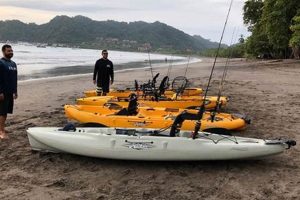
Anglers seeking new ways to enjoy their sport are increasingly turning to watercraft beyond traditional boats. Two popular choices for on-the-water angling offer distinct advantages and disadvantages: kayaks and stand-up paddleboards (SUPs). Choosing between these platforms involves considering factors like stability, mobility, storage capacity, and the type of fishing environment.
This growing trend offers a closer-to-nature experience, allowing access to shallow waters and secluded fishing spots often unreachable by larger vessels. It also promotes physical activity and presents a lower cost barrier to entry compared to motorized boats. The evolution of specialized fishing kayaks and paddleboards, equipped with rod holders, gear mounts, and even livewells, reflects the increasing popularity of these human-powered fishing methods.
The following sections will delve deeper into the specifics of each option, exploring their respective strengths and weaknesses to help anglers determine the best fit for their individual needs and fishing style.
Tips for Choosing Between a Kayak and Paddleboard for Fishing
Selecting the appropriate watercraft for fishing depends on several key factors. Careful consideration of these elements will ensure a safe and productive angling experience.
Tip 1: Assess Stability Needs: Kayaks generally offer greater stability than paddleboards, especially for beginners. This is crucial when casting, reeling, and landing fish. Anglers prone to seasickness or those fishing in choppy water should prioritize stability.
Tip 2: Consider Fishing Location: Paddleboards excel in calm, shallow waters, allowing access to areas kayaks can’t reach. Kayaks handle larger bodies of water and rougher conditions more effectively.
Tip 3: Evaluate Storage Capacity: Kayaks typically offer more storage for tackle, gear, and catches. Paddleboards can be equipped with storage solutions, but space is often more limited. Anglers planning longer trips or carrying more equipment might prefer a kayak.
Tip 4: Factor in Mobility and Transportation: Paddleboards are generally lighter and easier to transport than kayaks. Inflatable SUPs are particularly convenient for those with limited storage space. Kayaks often require roof racks or trailers.
Tip 5: Analyze Target Fish Species: The type of fish being targeted influences watercraft choice. Smaller species in shallow waters are readily accessible from a paddleboard, while larger fish in deeper waters might require the stability and capacity of a kayak.
Tip 6: Prioritize Comfort and Physical Capabilities: Standing for extended periods on a paddleboard can be tiring. Anglers with back problems or limited stamina might find a kayak more comfortable. Conversely, those who prefer a more active angling experience might prefer a SUP.
Tip 7: Budget Appropriately: Paddleboards often have a lower initial cost than kayaks. However, factoring in accessories like paddles, life vests, and fishing-specific gear can narrow the price difference.
By carefully weighing these considerations, anglers can make informed decisions about which watercraft best suits their fishing style, target species, and physical capabilities. The right choice enhances safety, enjoyment, and overall fishing success.
Ultimately, the best approach is to consider personal preferences and intended fishing applications to determine the optimal watercraft.
1. Stability

Stability is a critical factor when choosing between a kayak and a paddleboard for fishing. A stable platform is essential for casting, reeling, and landing fish, especially in challenging conditions. The inherent design differences between kayaks and paddleboards significantly impact their respective stability characteristics.
- Center of Gravity
Kayaks generally have a lower center of gravity due to the seated position, contributing to greater inherent stability. Paddleboards, with a standing position, elevate the angler’s center of gravity, making them more susceptible to tipping. This difference is particularly noticeable in windy conditions or when dealing with larger fish.
- Hull Design
Kayak hulls are typically wider and flatter than paddleboard hulls, providing a more stable base. Wider hulls displace more water, increasing buoyancy and resistance to tipping. Paddleboards, designed for gliding, often feature narrower, more streamlined hulls that prioritize speed over stability. However, specialized fishing paddleboards with wider platforms are available to address this concern.
- Water Conditions
Calm, flat water minimizes the stability differences between kayaks and paddleboards. However, in choppy water or strong currents, kayaks generally offer a more secure and stable platform. Paddleboards require greater balance and skill to navigate rough conditions, increasing the risk of capsizing.
- Angler Experience
Experienced anglers may be able to compensate for the inherent instability of a paddleboard through improved balance and technique. However, beginners are often more comfortable starting with the increased stability of a kayak. As confidence and skills develop, transitioning to a paddleboard becomes a viable option.
Ultimately, the choice between a kayak and a paddleboard for fishing depends on individual needs and preferences. Prioritizing stability, especially for beginners or those fishing in challenging conditions, often points toward a kayak. However, experienced anglers seeking the unique advantages of a paddleboard, such as shallow water access and a more active fishing experience, can mitigate stability concerns through careful technique and specialized equipment.
2. Maneuverability

Maneuverability plays a crucial role in the effectiveness of both kayak and paddleboard fishing. The ability to navigate tight spaces, change direction quickly, and position oneself optimally for casting and retrieving significantly impacts fishing success. Different hull designs, propulsion methods, and water conditions influence the maneuverability characteristics of each watercraft.
- Turning Radius
Kayaks, especially shorter, recreational models, generally have a tighter turning radius than paddleboards. This allows for quicker adjustments in position and more precise navigation through complex environments like mangrove tunnels or rocky shorelines. Paddleboards, with their longer profiles, require more space and effort to turn, making them less agile in confined areas.
- Tracking and Speed
Paddleboards typically track straighter and glide more efficiently than kayaks, especially in open water. Their longer, narrower hulls reduce drag, allowing for faster speeds and covering greater distances with less effort. Kayaks, while capable of speed, may require more corrective strokes to maintain a straight course. This can be advantageous for trolling or covering large areas but less so for navigating tight spots.
- Shallow Water Access
Paddleboards excel in shallow water navigation due to their smaller draft. They can easily glide over shallow flats, reefs, and other areas inaccessible to deeper-draft kayaks. This makes them ideal for sight fishing or targeting species that inhabit shallow waters. Kayaks, while offering specialized shallow-water designs, are generally limited by their hull depth.
- Current and Wind Effects
Wind and current significantly impact the maneuverability of both kayaks and paddleboards. Kayaks, with their lower profile and rudder or skeg systems (in some models), generally handle wind and current better than paddleboards. Paddleboards, with their larger surface area exposed to the elements, are more susceptible to being pushed off course, requiring more effort to maintain direction.
The optimal choice between a kayak and a paddleboard for fishing depends on the specific fishing environment and target species. Anglers fishing in confined areas with complex structures might prioritize the maneuverability of a kayak. Those fishing in open water or shallow flats might prefer the speed and shallow-water access of a paddleboard. Considering these factors alongside personal preferences and fishing style will ensure a more productive and enjoyable angling experience.
3. Storage Capacity

Storage capacity is a critical differentiator between kayaks and paddleboards for fishing applications. The ability to carry essential gear, tackle, and potential catches directly impacts the duration, range, and success of fishing trips. Kayaks and paddleboards offer distinct storage solutions, each with advantages and limitations.
Kayaks, particularly those designed for fishing, generally provide significantly more storage space than paddleboards. Dedicated compartments, hatches, and bungee systems accommodate tackle boxes, rods, coolers, and other essential equipment. Larger kayaks can even accommodate larger items like camping gear for multi-day expeditions. This ample storage allows anglers to carry a wider variety of tackle, prepare for diverse fishing scenarios, and extend trips without resupply. Paddleboards, by contrast, offer limited onboard storage. While some fishing-specific SUPs incorporate bungee systems and small dry bags, their overall capacity is considerably less than kayaks. This restricts the amount of gear and tackle that can be carried, potentially limiting fishing options and trip duration.
The impact of storage capacity on fishing effectiveness is substantial. Anglers carrying sufficient tackle and gear are better equipped to adapt to changing conditions, target different species, and handle unexpected situations. For instance, carrying extra line, lures, and tools allows anglers to address line breaks, switch fishing techniques, and make on-the-water repairs. Adequate storage also ensures the safe and efficient transport of catches, preventing spoilage and maximizing freshness. While innovative storage solutions are emerging for paddleboards, kayaks remain the preferred choice for anglers prioritizing storage capacity and extended fishing trips.
4. Accessibility

Accessibility, in the context of kayak versus paddleboard fishing, encompasses the ease with which individuals can transport, launch, and store these watercraft. Factors such as weight, size, portability, and storage requirements significantly influence the overall accessibility and convenience of each option, impacting the frequency and locations of fishing trips.
- Transportation
Transporting kayaks and paddleboards presents distinct challenges. Kayaks, often heavier and bulkier, typically require roof racks, trailers, or specialized vehicles for transport. This can limit spontaneity and increase travel complexity. Paddleboards, particularly inflatable models, offer greater portability. When deflated and packed, they fit easily into car trunks, simplifying transport and expanding access to remote fishing locations. Hard paddleboards, while less compact than inflatables, are generally lighter and easier to manage than kayaks.
- Launching
Launching a kayak or paddleboard involves different physical demands and site requirements. Kayaks, due to their size and weight, may require more effort to carry and launch, especially from steep banks or challenging terrain. Paddleboards, being lighter and more maneuverable, are generally easier to launch from various locations, including shallow shorelines and small access points. This increased launch flexibility expands fishing opportunities and reduces reliance on developed boat ramps.
- Storage
Storage requirements further differentiate kayaks and paddleboards. Kayaks require significant storage space, often necessitating garages, sheds, or specialized racks. This can pose challenges for individuals with limited storage options. Inflatable paddleboards, when deflated, require minimal storage space, easily fitting in closets or storage bins. Hard paddleboards, while requiring more space than inflatables, are generally easier to store than kayaks due to their smaller size and lighter weight.
- Physical Considerations
The physical demands of handling kayaks and paddleboards vary significantly. Kayaks, being heavier, require more strength and stamina for lifting, carrying, and maneuvering. This can present challenges for individuals with physical limitations. Paddleboards, particularly lighter models, are generally easier to handle, reducing physical strain during transport and launch. However, standing for extended periods on a paddleboard can pose its own physical challenges, particularly for individuals with balance or back issues.
The accessibility considerations associated with kayaks and paddleboards directly impact the practicality and convenience of each fishing platform. Evaluating transportation, launching, storage, and physical demands alongside personal circumstances and fishing preferences allows anglers to select the watercraft that best aligns with their individual needs and desired fishing experience.
5. Cost
Cost represents a significant factor influencing the decision between kayak and paddleboard fishing. Understanding the various cost components associated with each option allows for informed decisions aligned with budgetary constraints and desired features. Analyzing initial purchase prices, necessary accessories, maintenance expenses, and potential upgrade costs provides a comprehensive cost comparison.
Initial acquisition costs typically favor paddleboards. Entry-level paddleboards are generally less expensive than comparable kayaks. However, fishing-specific paddleboards, equipped with features like rod holders and gear mounts, can narrow this price gap. Kayak prices vary considerably based on size, material, and features, with higher-end fishing kayaks exceeding the cost of many paddleboards. Beyond the initial purchase, essential accessories contribute to the overall cost. Paddles, personal flotation devices (PFDs), and fishing-specific gear like rod holders and anchors represent additional expenses applicable to both kayaks and paddleboards. Depending on individual needs and preferences, these accessory costs can significantly impact the total investment.
Ongoing maintenance costs also warrant consideration. Kayaks and paddleboards require periodic cleaning, inspections, and potential repairs. Kayaks, particularly those constructed from composite materials, may incur higher repair costs due to their more complex construction. Paddleboards, especially inflatable models, are susceptible to punctures and require patching or replacement. Factoring in potential maintenance expenses provides a more realistic long-term cost assessment. Finally, upgrade potential influences long-term value. Kayaks often offer greater upgrade potential, accommodating accessories like fish finders, trolling motors, and advanced seating systems. Paddleboards, while offering some upgrade options, generally have a more limited upgrade path. Considering potential upgrades helps assess long-term cost implications and overall value.
6. Fishing Style

Fishing style significantly influences the suitability of kayaks versus paddleboards for angling. Different fishing techniques require specific watercraft characteristics, impacting stability, maneuverability, and access requirements. Understanding how fishing style aligns with watercraft selection ensures a more productive and enjoyable experience.
- Stillwater Fishing
Calm lakes and ponds offer an ideal environment for both kayaks and paddleboards. Kayaks provide excellent stability for casting and reeling, while paddleboards offer a unique elevated perspective for sight fishing. The choice often depends on personal preference and target species. For example, fly fishermen targeting trout might prefer the unobstructed casting platform of a paddleboard, while anglers pursuing bass might opt for the stability and storage capacity of a kayak.
- River Fishing
River fishing presents unique challenges requiring specific watercraft considerations. Kayaks, particularly those designed for river running, handle currents and obstacles more effectively than paddleboards. Their maneuverability and tracking capabilities are crucial for navigating moving water. Paddleboards, while suitable for slow-moving rivers, are less stable and more susceptible to being swept downstream in stronger currents. Fishing style further dictates watercraft choice. Anglers drifting bait or lures might prefer a kayak’s control, while those targeting shallow riffles might utilize a paddleboard’s shallow draft.
- Surf Fishing
Launching and landing through surf demands specialized watercraft characteristics. Kayaks designed for surf entry and exit provide stability and control in breaking waves. Paddleboards, while capable of surfing waves, require significant skill and experience to manage safely in surf conditions. Fishing from a paddleboard in the surf presents additional challenges related to stability and gear management. Therefore, kayaks are generally preferred for surf fishing due to their enhanced stability and handling in dynamic coastal environments.
- Offshore Fishing
Venturing offshore requires careful consideration of watercraft capabilities and safety. Kayaks designed for offshore fishing offer stability, storage, and features like rudders or skegs for navigating open water. Paddleboards are generally not recommended for offshore fishing due to their limited stability, reduced storage capacity, and susceptibility to wind and waves. The increased distance from shore and potential for challenging conditions necessitate the enhanced safety and performance characteristics of a specialized fishing kayak.
Matching fishing style with appropriate watercraft selection is crucial for maximizing success and ensuring safety. Analyzing specific fishing techniques, target species, and environmental conditions informs the choice between a kayak and a paddleboard. Prioritizing stability, maneuverability, and storage capacity based on individual fishing style ensures a more productive and enjoyable angling experience.
7. Personal Preference
Personal preference plays a pivotal role in the kayak versus paddleboard fishing debate, ultimately shaping individual experiences and influencing long-term satisfaction. While objective factors like stability and maneuverability are crucial, subjective preferences related to comfort, fishing style, and desired level of physical engagement often determine the ideal choice. Understanding the interplay between personal preference and watercraft selection empowers anglers to tailor their fishing experiences to individual needs and desires.
Several key personal preferences influence this decision. Comfort considerations, for instance, significantly impact enjoyment. Anglers who prefer a seated position might find kayaks more comfortable, especially during longer fishing trips. Those who enjoy standing and prefer a more active angling experience might gravitate toward paddleboards. Fishing style further intertwines with personal preference. Anglers prioritizing stealth and shallow-water access might favor paddleboards, while those engaging in trolling or bottom fishing might prefer the stability and storage capacity of kayaks. Physical capabilities also factor into personal preference. Individuals with balance issues or limited stamina might find kayaks more suitable, while those seeking a more physically demanding experience might choose paddleboards. Real-world examples illustrate this connection. An angler with knee problems might find the seated position of a kayak essential for comfortable fishing, while a physically fit angler seeking a core workout might prioritize the standing position of a paddleboard.
Recognizing the significance of personal preference optimizes equipment choices and enhances fishing enjoyment. Ignoring personal preferences can lead to dissatisfaction and hinder long-term engagement in the sport. Aligning watercraft selection with individual comfort, fishing style, and physical capabilities promotes a more positive and rewarding experience. Ultimately, acknowledging the subjective nature of personal preference empowers anglers to make informed decisions that maximize enjoyment and foster a deeper connection with the sport.
Frequently Asked Questions
This section addresses common inquiries regarding the choice between kayaks and paddleboards for fishing, offering concise and informative responses to facilitate informed decision-making.
Question 1: Which option offers greater stability for fishing?
Kayaks generally provide greater stability due to their lower center of gravity and wider hull design. This is particularly advantageous for beginners or when fishing in rough conditions.
Question 2: Which is better suited for fishing in shallow water?
Paddleboards excel in shallow water due to their minimal draft, allowing access to areas inaccessible to most kayaks. This makes them ideal for sight fishing in shallow flats and backwater areas.
Question 3: Which option offers more storage capacity for gear and catches?
Kayaks generally offer significantly more storage space than paddleboards, accommodating larger tackle boxes, coolers, and other essential equipment for longer trips.
Question 4: Which is easier to transport and store?
Paddleboards, especially inflatable models, are generally easier to transport and store due to their lighter weight and smaller packed size. Kayaks often require roof racks or trailers for transport and dedicated storage space.
Question 5: Which is more suitable for different fishing styles?
The suitability depends on the specific fishing style. Kayaks are generally preferred for trolling, bottom fishing, and offshore fishing due to their stability and storage. Paddleboards are often favored for sight fishing, fly fishing in calm waters, and accessing very shallow areas.
Question 6: What are the primary cost considerations for each option?
While initial purchase costs can be lower for paddleboards, the overall cost depends on factors like accessories, fishing-specific features, maintenance, and potential upgrades. A comprehensive cost assessment should consider all these elements.
Careful consideration of these frequently asked questions, alongside individual needs and preferences, helps anglers determine the optimal watercraft for their fishing endeavors.
Beyond these frequently asked questions, additional resources and expert advice can further refine the decision-making process.
Kayak vs Paddle Board Fishing
The decision between a kayak and a paddleboard for fishing hinges on a careful evaluation of individual needs, fishing styles, and environmental factors. Kayaks offer greater stability, storage capacity, and suitability for challenging conditions, making them ideal for anglers prioritizing safety, extended trips, and diverse fishing techniques. Paddleboards excel in shallow-water access, maneuverability in calm conditions, and a more active angling experience, appealing to anglers targeting specific species in shallow, accessible environments. Factors such as transportation, storage, cost, and personal preferences further refine the selection process, highlighting the importance of a comprehensive assessment.
Ultimately, the optimal choice empowers anglers to connect with the water in a way that aligns with their individual preferences and fishing aspirations. As technology advances and specialized designs emerge, both kayaks and paddleboards continue to evolve, offering increasingly refined options for anglers seeking a closer connection with nature and the thrill of the catch. Careful consideration of the factors presented herein enables informed decisions, enhancing fishing experiences and fostering a deeper appreciation for the sport.