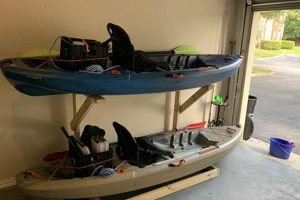
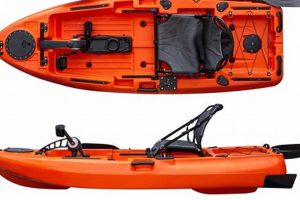
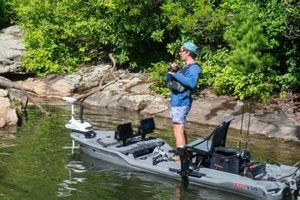
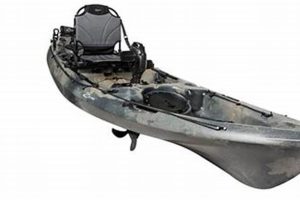
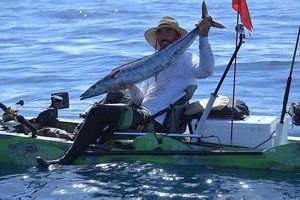
Anglers of greater stature require specialized watercraft designed to accommodate their longer legs and higher center of gravity. These specialized kayaks prioritize stability and comfort, featuring adjustable seating systems, increased cockpit dimensions, and higher weight capacities. An example would be a sit-on-top kayak with ample legroom and a weight capacity exceeding 300 lbs, equipped with adjustable foot braces and a high-backed seat.
Properly sized vessels are essential for a comfortable and enjoyable fishing experience. Discomfort stemming from cramped quarters or an unstable platform can detract from the focus required for successful angling. Historically, individuals with longer limbs often faced limited options in the kayak market. Recent advancements in design and manufacturing have addressed these limitations, providing a wider array of choices optimized for taller anglers. This ensures enhanced stability, improved paddling efficiency, and reduced risk of physical strain.
Key considerations for selecting suitable watercraft for taller individuals include cockpit size, weight capacity, seat adjustability, and hull design. Subsequent sections will delve deeper into each of these aspects, providing a comprehensive guide to making an informed purchase decision.
Tips for Selecting Kayaks for Taller Anglers
Choosing the right kayak is crucial for comfort, stability, and overall fishing success. Careful consideration of specific design features will ensure optimal performance and enjoyment on the water.
Tip 1: Measure Cockpit Dimensions: Cockpit length and width are critical. Ample legroom is essential to prevent cramping and discomfort during long fishing trips. Look for kayaks with extended cockpit dimensions specifically designed for taller individuals.
Tip 2: Check Weight Capacity: A kayak’s weight capacity should comfortably accommodate the angler’s weight, plus gear and any potential catch. Exceeding the weight limit can compromise stability and performance.
Tip 3: Prioritize Adjustable Seating: Adjustable seats and foot braces allow for customized positioning, ensuring proper posture and paddling efficiency. Look for seats with adjustable backrests and ample lumbar support.
Tip 4: Consider Hull Design: Longer, wider hulls generally offer greater stability, while shorter, narrower designs prioritize speed and maneuverability. Consider individual needs and fishing style when selecting a hull design. Wider kayaks are often preferable for larger individuals.
Tip 5: Test Before Purchasing: Whenever possible, test potential kayak models on the water. This allows for firsthand assessment of comfort, stability, and maneuverability. Pay close attention to legroom and seating comfort.
Tip 6: Evaluate Storage Options: Ample storage space is essential for carrying fishing gear, tackle boxes, and personal items. Consider the location and accessibility of storage compartments.
Tip 7: Research Kayak Materials: Kayaks are constructed from various materials, each with its own advantages and disadvantages. Consider factors such as durability, weight, and maintenance requirements.
By carefully considering these factors, anglers of greater stature can select a kayak that provides optimal comfort, stability, and fishing performance. Choosing the right vessel contributes significantly to a more enjoyable and productive angling experience.
Armed with these insights, individuals can confidently embark on the search for the perfect fishing kayak tailored to their specific needs and preferences.
1. Legroom

Adequate legroom is a critical factor in kayak selection, particularly for taller individuals. Restricted leg movement can lead to discomfort, cramping, and reduced circulation, significantly impacting fishing performance and overall enjoyment. The connection between legroom and kayaks designed for taller anglers is directly related to comfort and the ability to maintain proper posture for extended periods. Insufficient legroom can hinder paddling efficiency and make casting difficult. For example, an angler with long legs crammed into a small cockpit may experience knee pain and be unable to effectively brace against the kayak, impacting stability. This discomfort can curtail fishing trips and diminish the overall experience.
Kayak manufacturers address this issue by designing cockpits with increased length and width, along with adjustable foot braces. These features allow taller anglers to extend their legs comfortably and maintain a stable and balanced position. Adjustable footrests are crucial as they accommodate varying leg lengths and allow for customized positioning. The ability to adjust leg position also contributes to efficient paddling technique, conserving energy and reducing strain. This is particularly important for longer fishing expeditions or when paddling against currents or wind. In practical terms, sufficient legroom translates to a more comfortable and enjoyable fishing experience, allowing anglers to focus on the sport rather than physical discomfort.
In summary, the availability of ample legroom directly influences the suitability of a kayak for taller individuals. Prioritizing this aspect ensures comfort, promotes proper paddling technique, and enhances the overall fishing experience. Challenges related to limited legroom can be effectively addressed through careful kayak selection, focusing on models with extended cockpit dimensions and adjustable footrests. Understanding the importance of legroom empowers taller anglers to make informed decisions and choose kayaks that meet their specific physical requirements.
2. Seat Adjustability
Seat adjustability plays a crucial role in the comfort and performance of taller anglers using fishing kayaks. Proper posture and support are essential for maintaining balance, efficient paddling, and enduring long hours on the water. The connection between seat adjustability and kayaks designed for taller individuals lies in accommodating varying torso lengths and leg-to-torso ratios. A fixed, non-adjustable seat may position a taller angler too low or too high, compromising both comfort and paddling efficiency. An improperly positioned angler may experience back pain, reduced paddling power, and difficulty maintaining balance, particularly in challenging conditions.
For instance, an angler with a long torso may require a higher seat back for adequate support. Conversely, a shorter torso may benefit from a lower seat position to maximize legroom. Adjustable seats offer the flexibility to customize the seating configuration to individual needs. This customization can include adjusting the height of the seat back, the angle of the seat bottom, and the position of lumbar support. Some kayaks even offer adjustable foot braces synchronized with the seat, ensuring optimal ergonomics. The practical significance of this adjustability is readily apparent. A comfortable and properly supported angler can paddle more efficiently, maintain balance more effectively, and fish for longer periods without experiencing discomfort or fatigue.
In summary, the ability to adjust the seat is a critical feature in fishing kayaks designed for taller individuals. It directly addresses the challenges posed by varying body proportions and ensures optimal comfort, support, and paddling efficiency. Kayaks with adjustable seating systems empower taller anglers to customize their cockpit setup, leading to a more enjoyable and productive fishing experience. Neglecting this aspect can result in discomfort, reduced performance, and potentially even injury. Therefore, prioritizing seat adjustability is paramount when selecting a fishing kayak for a taller angler.
3. Weight Capacity

Weight capacity is a critical consideration when selecting a fishing kayak, particularly for taller individuals. Taller anglers often have a larger build and therefore weigh more. Additionally, they require kayaks with larger dimensions to accommodate their longer legs, which inherently contributes to the overall weight of the vessel. Selecting a kayak with insufficient weight capacity can compromise stability, maneuverability, and safety. Overloading a kayak can lead to decreased freeboard (the distance between the waterline and the top edge of the hull), increasing the risk of swamping, especially in rough conditions. This underscores the importance of carefully assessing weight capacity in relation to the angler’s weight, gear, and potential catch.
- Total Weight Calculation:
Accurate calculation of the total weight to be carried is essential. This includes the angler’s body weight, the weight of the kayak itself, fishing gear (rods, reels, tackle boxes), and any potential catch. Forgetting to factor in these additional weights can lead to exceeding the kayak’s capacity, negatively impacting performance and safety. For example, a 200-lb angler with 50 lbs of gear in a kayak with a 250-lb capacity is already at the limit, leaving no room for the added weight of fish. This necessitates careful planning and realistic assessment of potential load.
- Stability and Performance:
Weight capacity directly impacts stability and performance. A kayak loaded near its maximum capacity will sit lower in the water, reducing maneuverability and increasing the risk of capsizing. Conversely, a kayak with ample weight capacity will provide greater stability, especially in challenging conditions such as wind or choppy water. This is particularly important for taller anglers who have a higher center of gravity and may be more susceptible to instability.
- Safety Considerations:
Exceeding the weight capacity compromises safety. A heavily loaded kayak is more difficult to control and more likely to capsize. Furthermore, a lower freeboard increases the risk of water entering the cockpit, potentially leading to swamping. Understanding and adhering to the manufacturer’s specified weight limit is crucial for safe and enjoyable kayaking.
- Kayak Design and Materials:
Kayak design and materials influence weight capacity. Longer and wider kayaks generally have higher weight capacities. Materials such as polyethylene are durable and offer higher weight limits compared to lighter materials like fiberglass or composites. The construction and design of the kayak should be considered in relation to the intended use and the angler’s size and weight. For instance, a wider, more stable polyethylene kayak would be a suitable choice for a taller angler carrying heavier gear.
In conclusion, understanding weight capacity is essential for selecting a safe, stable, and performant fishing kayak for taller anglers. Careful consideration of body weight, gear, potential catch, and the kayak’s specified limit ensures optimal performance and a safe, enjoyable experience on the water. Neglecting this crucial aspect can compromise stability, maneuverability, and ultimately, safety.
4. Stability
Stability is a paramount concern in kayak selection, especially for taller individuals. A higher center of gravity, inherent in taller physiques, necessitates a kayak design that prioritizes stability to mitigate the risk of capsizing. Cause and effect are directly linked: a less stable kayak coupled with a higher center of gravity increases the likelihood of tipping. This connection is crucial because maintaining balance is essential for casting, reeling, and landing fish, particularly in challenging conditions like wind or current. For example, a taller angler in a narrow, unstable kayak might find it difficult to maintain balance when casting a fishing rod, increasing the risk of tipping. Conversely, a wider, more stable kayak provides a secure platform for various fishing activities.
Wider hulls and flatter bottoms generally contribute to greater stability. Features such as outriggers and pontoons can further enhance stability. The practical significance of this understanding lies in selecting a kayak that provides a secure and balanced platform, enabling anglers to focus on fishing rather than constantly battling to stay upright. Consider a scenario where an angler hooks a large fish. The fight and subsequent landing require stability to maneuver the kayak effectively and prevent capsizing during the struggle. A stable kayak provides the necessary platform to manage these dynamic situations. Furthermore, stability enhances angler confidence, allowing for more aggressive casting techniques and exploration of diverse fishing locations.
In summary, stability is a non-negotiable factor for taller anglers when choosing a fishing kayak. Understanding the relationship between height, center of gravity, and kayak design empowers informed decision-making. Prioritizing stability not only enhances safety but also contributes to a more comfortable, enjoyable, and ultimately, successful fishing experience. A stable kayak provides the foundation for confident casting, effective fish fighting, and safe navigation, enabling taller anglers to fully enjoy their time on the water.
5. Paddle Length
Paddle length is a crucial factor influencing paddling efficiency and comfort, particularly for taller individuals in fishing kayaks. An incorrectly sized paddle can lead to fatigue, reduced performance, and potential strain. Proper paddle length ensures effective strokes, maximizing propulsion while minimizing physical exertion.
- Torso Height and Kayak Width:
Torso height and kayak width are primary determinants of appropriate paddle length. Taller individuals generally have longer torsos, necessitating longer paddles. Kayak width also plays a role, as wider kayaks require longer paddles to reach the water effectively. For instance, a taller angler in a wide fishing kayak would require a significantly longer paddle compared to a shorter angler in a narrower recreational kayak. Accurate measurement and consideration of both torso height and kayak width are essential for optimal paddle selection.
- Paddling Style and Angle:
Paddling style and angle influence optimal paddle length. High-angle paddling, often used for speed and maneuverability, typically benefits from slightly shorter paddles. Low-angle paddling, employed for touring and long-distance paddling, generally requires longer paddles. Fishing kayaks often involve a combination of paddling styles, necessitating a paddle length that balances maneuverability and efficiency. Consider an angler frequently switching between high-angle paddling for navigating tight spots and low-angle paddling for covering longer distances; selecting a mid-range paddle length would offer versatility.
- Performance and Efficiency:
Correct paddle length directly impacts paddling performance and efficiency. A paddle that is too short requires more strokes to cover the same distance, leading to increased fatigue and reduced speed. Conversely, a paddle that is too long can be cumbersome and difficult to control, hindering maneuverability and potentially causing strain. Efficient power transfer and comfortable paddling are achieved through proper paddle length selection, enabling anglers to cover greater distances with less effort and maintain optimal performance throughout their fishing trip.
- Physical Comfort and Injury Prevention:
Proper paddle length contributes significantly to physical comfort and injury prevention. Using a paddle that is too short can strain shoulders, back, and wrists due to overexertion and improper paddling mechanics. Similarly, a paddle that is too long can cause awkward posture and strain on joints. Choosing the correct paddle length promotes proper body mechanics, reduces strain, and minimizes the risk of paddling-related injuries, ensuring a comfortable and enjoyable fishing experience. This is particularly important for taller anglers who may be more susceptible to shoulder and back strain.
In conclusion, selecting the correct paddle length is essential for optimizing paddling efficiency, comfort, and injury prevention for taller anglers in fishing kayaks. Careful consideration of torso height, kayak width, paddling style, and potential physical strain ensures the selection of a paddle that enhances performance and contributes to a positive on-the-water experience. Understanding these factors empowers taller anglers to make informed decisions, ultimately leading to more enjoyable and productive fishing trips.
6. Storage Capacity
Storage capacity is a critical factor influencing the practicality and enjoyment of fishing kayaks, especially for taller individuals. Taller anglers often require larger kayaks with increased cockpit dimensions for comfort and stability. This increase in overall kayak size often, but not always, translates to greater storage potential. The connection between storage capacity and kayaks designed for taller anglers lies in the need to accommodate not only the angler’s physique but also the essential gear required for a successful fishing trip. Cause and effect are directly related: insufficient storage leads to limited gear capacity, impacting fishing effectiveness and overall enjoyment. Imagine a taller angler embarking on a multi-day fishing expedition with limited storage space. The inability to carry sufficient tackle, food, water, and safety equipment can compromise both the success and safety of the outing. Conversely, ample storage allows for carrying a wider array of fishing gear, enhancing versatility and preparedness for diverse fishing scenarios.
Practical examples illustrate this significance. A taller angler targeting different species might need to carry multiple rods and reels, each rigged with specific lures or bait. Adequate storage allows for organized transport of this equipment, preventing tangling and damage. Furthermore, larger kayaks often have designated storage compartments for items like tackle boxes, fish finders, and safety gear. This organized storage enhances efficiency and accessibility, crucial during dynamic fishing situations. Consider a scenario where an angler needs to quickly access a specific lure or piece of equipment; well-designed storage compartments facilitate rapid retrieval, minimizing disruption to the fishing process. Moreover, secure storage protects valuable equipment from water damage and loss, especially in rough conditions or during accidental capsizing.
In summary, storage capacity directly impacts the functionality and enjoyment of fishing kayaks for taller individuals. The ability to carry sufficient gear, including rods, reels, tackle, safety equipment, and personal items, enhances preparedness, versatility, and overall fishing success. Challenges related to limited storage can be effectively addressed through careful kayak selection, prioritizing models with ample and well-designed storage compartments. Understanding the importance of storage capacity empowers taller anglers to make informed decisions, ensuring they have the necessary equipment readily available for a productive and enjoyable fishing experience.
Frequently Asked Questions
This section addresses common inquiries regarding kayak selection for taller anglers.
Question 1: What is the minimum recommended cockpit length for a tall angler?
While individual needs vary, a cockpit length of at least 50 inches is generally recommended for anglers over 6 feet tall. This provides sufficient legroom to prevent cramping and discomfort.
Question 2: How does seat adjustability impact long-term comfort?
Adjustable seating systems allow for customized positioning, ensuring proper posture and support, which are crucial for preventing back pain and fatigue during extended fishing trips.
Question 3: Why is weight capacity a critical consideration for taller anglers?
Taller individuals often require larger kayaks, which inherently weigh more. Additionally, their own weight combined with gear requires a higher weight capacity to maintain stability and performance.
Question 4: How does kayak stability relate to angler height?
Taller anglers have a higher center of gravity, making them more susceptible to tipping. Kayak stability is paramount for maintaining balance, particularly during casting and reeling.
Question 5: How is the appropriate paddle length determined for a taller kayaker?
Paddle length is determined by a combination of torso height and kayak width. Taller individuals with longer torsos paddling wider kayaks typically require longer paddles for efficient strokes.
Question 6: What storage features should taller anglers look for in a fishing kayak?
Ample and strategically placed storage compartments are essential for carrying fishing gear, tackle boxes, and personal items. Consider dedicated compartments for specific items and overall storage capacity.
Careful consideration of these factors ensures selection of a kayak that meets the specific needs and physical requirements of taller anglers.
The next section will explore specific kayak models recommended for taller individuals.
Fishing Kayaks for Tall Guys
Selecting appropriate fishing kayaks for taller individuals necessitates careful consideration of several key factors. Ensuring adequate legroom and seat adjustability directly addresses comfort and long-term physical well-being. Prioritizing a suitable weight capacity maintains stability and safe operation, while understanding the impact of angler height on stability is crucial for preventing capsizing. Proper paddle length selection promotes efficient paddling and injury prevention, and ample storage capacity allows for carrying essential gear and equipment. Addressing these key areas ensures a comfortable, safe, and productive fishing experience.
The information presented provides a framework for informed decision-making. Appropriate kayak selection empowers taller anglers to fully enjoy the sport, enhancing performance and maximizing time on the water. Careful consideration of these factors transforms potential challenges into opportunities for a rewarding and enriching fishing experience.